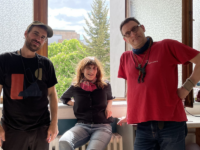
For the conclusion of our 2-part conversation with creative jazz drummer and composer Devin Gray, the Maine-born musician speaks of his increasing ties to Europe and how the fertile Berlin music scene environment gave him new ways to flourish.
S. VICTOR AARON: So now I want to shift over to Europe, but not quite Berlin yet.
DEVIN GRAY: Okay.
S. VICTOR AARON: Tell me a little bit first about your Belgian quartet, and how that came together, and what do you see as the special sauce in that band?
DEVIN GRAY: I love you. Hearing you, thanks for saying that, like that, too.
So I moved to New York from Baltimore in 2006. I wasn’t going to pursue more degrees because of money and the whole thing, and then someone said, you should just audition, and I went up there and did an audition (for the Manhattan School of Music) and pretty much crushed it. And then they said, “okay, here’s some money,” and so suddenly, oh shit, I think I’m moving to New York. I want to keep going, I want to meet more people, and I always wanted to live in New York as a Mainer, because I got that bug during the jazz camp days in high school. I always wanted to be in New York, but then I went into the school in Baltimore. By the time I got to New York it was it was “go” time, and of course, I was younger, I was 23; this is 20 years ago. I’m meeting all these people at the school, and the thing that I love about New York, and global connectivity of the arts at large, not closed borders, not artist visas. I’m talking about supporting the artist communities. The Europeans were in and out all the time, everyone’s awesome, (and I’m) mixing with people from there.
I’m in this academic situation, and I’m meeting some really heavy people from all over the world, because that’s their chance to get their government to pay their tuition to go to New York and hang out and meet everybody. So, you had the whole German crew, you had the Belgian crew, you had the French crew, you had the Danish crew, you had the Swedish crew. That was how Gary Thomas and (bassist) Joel Gripp and I started playing, because Joel Gripp came from Sweden to study with Michael Formanek, specifically, because he’s a nasty bass player. (Saxophonist) Robin Verheyen was in there, and we were students together. Here’s a brilliant musician, much like the saxophone player that I was telling you that I grew up with, that all of our circle knows, this guy is just a master wizard of music, and has the sound, and also just had the fire for music, and we’re all in this school going. And that was just such a powerful moment in life. Robin and I immediately I clicked, and with our friend (guitarist) Ryan (Pate) we did a beautiful guitar/soprano sax/drums trio record, (now on Bandcamp at https://devingraymusic.bandcamp.com/album/satyagraha). And then, everyone goes in their own directions, and basically I ended up starting to spend time in Belgium during the pandemic.
I started realizing I’m connecting with these people and on the internet because of COVID, and shit got really bad. Of course, as I roll, I don’t stop writing music. I don’t stop thinking of ideas, I don’t stop trying to record with my friends or new friends in New York. It’s just a continuum, 100%. I was there in Belgium, and I gotta find a studio. Robin and I were in touch, because I’m there, and he had been playing a lot with (pianist) Bram (De Looze), who I didn’t
really know from New York. But Robin and I clocked a lot of time together in New York, and over the years, too, so we already are on the same page, about the same generation, so he knows… also, compositionally, too. I wanted to do something with that music, and so (we brought in) this bass player (Nicolas Thys) and I just booked a studio. I had to wait a little bit, just because everything was slow, but, like, in the end, I did really want to get that out, too, and so I pressed release, because I did want that to exist as a part of my story just like anything else, it’s all just the truth (Note: the resultant album To The Point is available here: https://devingraymusic.bandcamp.com/album/to-the-point).
At a certain point, maybe I can get some support from Belgians, or some financier in the US, that would be an ultimate dream as a composer, because, these projects take a lot of time, and a lot of money, and I have a billion ideas waiting, but of course, it’s also just reality, it’s fine, but I’d love it at some point if somebody offered some support to, do these ideas. Just to blend that into labels again, look at Kris Davis’ label (Pyroclastic Records). Basically, that’s a perfect segue to why that is so important, also, and beneficial to the community, man. This is because someone is footing some of these bills, I mean, we don’t need to go into names, but to make the art work. It’s being funded, which is a beautiful, beautiful, necessary, more than ever, thing to keep people moving, and look at what it’s done. Look what Pyroclastic Records has achieved because of that support, and it’s amazing. I think if more people recognize that you don’t need that much money to support the arts, we can do a lot with a little. We’re used to that, so we’re actually professional at that. In Europe that’s a whole other game, where there are actual subsidies that do function in the current year’s price index and all these things, where they’re actually trying to raise the bar into where it probably needs to be to be a functioning artist in the world, to be an existing artist. I can’t really say the same about New York or the States.
S. VICTOR AARON: Okay, so finally, I want to move to Berlin, and I’m really looking forward to getting this part. Because, from where I sit, it seems that Berlin’s become a such a creative music hotspot. It’s particularly the experimental, improvised music scene, and it’s not just jazz. I also know that you’ve been familiar with that scene since 2012, right?
DEVIN GRAY: But before 2012..
S. VICTOR AARON: So you’ve been going there on and off, I guess, for a very long time. Describe that scene to me, and why it’s just become a magnet for creative artists all around the world, and not just New York.
DEVIN GRAY: First off, we’re dealing with countries and histories. We have the United States, which is a baby, while the Europeans have a lot of history. You know, it’s funny, because people think Germany and Berlin are all about, World War II and Nazis, when the Germans did a whole shit ton of stuff before that happened. The development of their society at large has a very different focus, in my humble opinion. Because of the years of development and mistakes, and experiences and trials and errors, it turns out that if you fund people a little bit via with more support systems, then they usually do better. Funding poets through the German history of poets and their society, Renaissance music and musicians functioning like that to Bach and church-supported music. What did (America) import for music? We imported a bunch of white European music. But we have our (own) classical music, like Duke Ellington to me, let’s just put it that way. There are all these different systems like Berlin they have the theater system in Germany specifically, because the way Germany was developed in small villages all these things over centuries of history. They loved theaters, and so every little village’s kingdom had a theater. And then guess what? A lot of those theaters still exist. Maybe they’re not fully functional, but they’re a hell of a lot more functional than the way things are set up in the United States, outside of pure capitalism, obvious pop culture things.
Germany’s attitude is, “We want you to be an artist, we want you to do things, we want you to go out of your mind and create weird shit and call it, like, the New Berlin sound,” so there’s a lot more opportunities for the breeding of culture at large, and the support. Berlin is a beautiful example of that, because they want things to flourish, and because they know that life can be better because of that, because of past experiences, not just World War II, but the evolution of all of it, including Europe and the movement of people from different countries changing places and mixing cultures.
But a lot of that is, like, the melting pot, which was the attraction of New York for me, especially in the beginning, where it’s like, oh shit, all these jazz musicians are here? Oh, they all live in the East Village? Oh my god, that’s the history? Oh my god, they all live in Harlem, and they took that photo? Is it still like that? Actually, it kind of is, but it’s in Brooklyn now. New York has that energy, that is a part of my lifestyle, which I love, and Berlin is just the equivalent of that, because of the support. That attracts people from all over. That means not just the free avant-garde musicians doing whatever get funding, but also the jazz musicians, also the poets, also the theater composers.
In the last couple years since COVID, Berlin is starting to get really busy, it’s starting to remind me of New York in a way that it did not any of those years before. The internet and tech things take over, and people are buying less music and supporting less music. The margins and everything start to get very narrow, very quickly. But look over there in Europe, it’s not all roses and daisies, and they’re fighting their asses off politically, also, because the politicians are still controlling that, and the more the conservative you are, guess what? The less arts funding they want, because they don’t want you to do your shit. But the Germans are also very good in putting things and supporting things systematically, and I would say that the Americans have absolutely, as an American, have absolutely no clue how to really pull that off. But also, that might be deeply a problem in our society of understanding of arts and culture that isn’t there yet because of the history, because we’re young compared to Europeans’ long, long traditions.
S. VICTOR AARON: So now, finally I want to get to your Berlin-based trio with Andrea Parkins and Frank Gratkowski. Tell me about how that came together, and what’s the character
and the mission statement of that particular trio.
DEVIN GRAY: In 2012, I did the record, Dirigo, there was a lot of energy around that, I had a lot of great, beautiful kickbacks for various reasons. I thank (publicist) Ann Braithwaite a lot, and Paul Lichter, and obviously the band from there. It was a beautiful moment in my life. And then I kept going, boom, boom, boom, but I also realized, hmm, I don’t really have any work still in the summers. I was teaching a lot, in Westchester (County, NY) and I realized I needed to go somewhere else. And every summer since I moved to New York, I would probably go to Maine, because that’s where my parents are, I could kind of hang out. I was in and out of town a lot, and then I realized 2012 maybe I’ll just go back over to Europe, I got a bunch of friends there. Meanwhile, Joel Grip and all these people that I already knew had also moved to Berlin for the exact same reasons. They were in Copenhagen, they were in Paris, and all these cities and it’s not as happening as it was for them. So, 2012, I started subletting (my apartment), and I did that basically every year: ‘12, ‘13, ‘14, ‘15, ‘16, ‘17, ‘18, ‘19, and then the pandemic is when I officially moved. So, in 2017, I applied for the artist visa, not thinking I would move there, and just had it in the background, the door was open, that was great.
My mother lives in Italy, so everything was cool. So I was just kind of flowing and playing and doing the dream. But in 2012, I was subletting, and at the same time in Berlin, because I could sublet my room for less in Berlin than in New York, because it’s cheaper there. I’m going out to the gangs, checking out the scene, finding out what the hell’s going on in Berlin. In ‘12, ‘13, ‘14, I’m just doing my thing in Berlin outside, and then that was when I realized, “Andrea Parkins, oh, Ellery (Eskelin), oh, wait, oh, there’s a connection.” Then I finally met Andrea, somewhere around that time. Because she was on the scene, because she was also exactly what I just said. I’m sure she’d say similar things, like, “dude, get the hell out of America, because ain’t nobody supporting you.” And if you’re actually creative and want to try weird things, people are definitely not supporting you, and that is just something that is a painful reality of being an American citizen. Ellery’s told me she likes it over (in Berlin), I think, because of these things.
Then, Frank (Gratkowski) was just on the scene heavy at that time, and watching him play, I thought I could play with these people. And also, everyone was just so much more chill and relaxed, and not so stressed about money. You know, it didn’t (require) everybody to spend a million dollars to do a gig, because everyone’s just doing the door or they have subsidies, and it’s not that expensive. There’s less pressure on living, more pressure on making cool shit, and that’s exactly what I’m in it for.
I started wondering if they’d play a trio gig with me, and then that’s basically how it started. We played and I had some friends that were booking gigs, a Ukrainian that moved over in 2014 because of Crimea, and all. That was the first major wave of displacement from some Ukrainians, so I started meeting Ukrainians in Berlin, as well as Russians and Turks, etc, I don’t know what any of this is, I’m not finding this in New York, I don’t know what this thing is, and so immediately from 2012, you were exposed to all that. I’m learning about Frank, and he’s just fun, he’s such a badass musician, everybody knows him, and he was touring in the States also, so for him, it was fun to connect with Andrea and me, because we’re American, and for us, it’s fun to connect with him, because he’s (German). Frank has a large view of the world, and of improvisation. He’s toured everywhere in the States, people know him all over, and I didn’t really know that, but he knew that, and he’s down to play music. So the trio kind of started then, (but) it was a slow-moving project, because I was still living in New York full-time.
So, anyway, that trio plays here and there, and then we played, I think, last year I thought, well, with the pandemic, I need to record this, because I don’t know, someone might die. This was an important part of my development in Berlin, even before I moved here, and they’ve always been so friendly and nice. It’s nice to be connected with Andrea and work with artists of that stature, which is just a pure privilege either way, no matter how you look at it in my development, in their development and in the experiences.
I finally decided we’re just gonna record it, and of course, in Berlin. And then, you know, some years went by, I did the solo record (Most Definitely) in ‘23, and then finally in ‘24, and ‘25, we played again. A ‘26 came in, I thought, you know what? Let’s do another gig, and let me actually get this out there, and I actually want to get people to kind of hear it, because it’s a part of my thing, just as much as my prior records. I want people to hear, I want them to listen, I want them to understand that about me, all of these styles and approaches are just all a part of how I’m exploring music still, and how I’m actually ultimately just getting joy from music by doing all these different things. Playing straight ahead doesn’t change me from playing with the Hz of Gold (available on Bandcamp here: https://devingraymusic.bandcamp.com/album/hz-of-gold). It’s all the same.
S. VICTOR AARON: If someone came to you and they said, “I really want to learn the drums, I want to get serious about it,” who would you point out to say, “go study this drummer’s life.”?
DEVIN GRAY: Well… I mean… There’s so many choices within that. But, I’m still, like, a huge geek fan of Max Roach. If I could get anywhere closer to anything that that dude did
then I would actually feel almost like I’ve accomplished something. I still want people to reflect, like with gun violence, on the fact that guys like him were innovators on such a level that didn’t exist before. So, Max is so much that for me, so I would say, yeah, I mean, you want to learn how to play anything, like, you should probably be able to play, a thing or two in the direction of what this person did in the history of music, just as much as learning Bach’s counterpoint or John Coltrane’s “Sheets of Sound.”
S. VICTOR AARON: When we were talking about Melt All the Guns, I was thinking about the Freedom Now Suite from Max Roach. That was, to me, one of the boldest statements in jazz, particularly. Especially because of when it came out, when it did.
DEVIN GRAY: Totally.
S. VICTOR AARON: And I wondered, were you thinking about that when you were making The Melt All the Guns records?
DEVIN GRAY: I honestly have to say no, because the thing is, his reasoning was also coming from a different place, you know? And same with mine, where it’s just a personal statement that needed to be said. His is obviously monumental, and it comes with so much history of struggle and oppression that continues to this day, which is still why I think artists should be making statements. I mean, not necessarily just political, but why artists (should) probably make statements in general, because — I don’t know if you’ve looked at the news lately — but it’s a pretty dark world that we’re kind of dealing with. That is what shapes society, so if you care about yourself and anybody around you, you should probably be invested in trying to learn more about each other, and what you can do to help people, and simply put, and also what you can give to people. These are the types of things that I think about.

- Ivo Perelman + Matthew Shipp – ‘Duologue 7: Distillation’ (2026) - October 6, 2026
- Samuel Bonnet Trio feat. Joe Magnarelli, “Liberation” from ‘Slow’ (2026): Video Premiere - October 5, 2026
- Christy Doran + Imran Khan – ‘Disambiguation’ (2026) - October 2, 2026