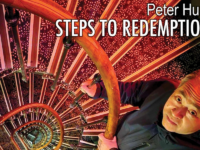
(feature photo provided by Peter Hum)
When the Ottawa Citizen‘s Citizen’s restaurant critic and longtime editor Peter Hum is able to take time to indulge in his love for music making, it’s noteworthy because you better believe he uses his precious time to make the music count. Steps to Redemption (read the review here) is his just-released fourth album in 16 years and once again, he’s assembled the best jazz musicians from all of Canada to render a fresh batch of his compositions. I recently caught up with the affable, graceful and candid Peter Hum — the pianist, composer and bandleader side of him — to get insights on the new album, his approach to music and his band, as well as how he came to successfully juggle two noteworthy careers.
S. VICTOR AARON: Tell me how you ended up being both a serious journalist and a serious musician.
PETER HUM: Both of these things that you’re talking about date back to my high school days. I grew up in Ottawa, the capital of Canada, and I went to an academically oriented high school where I had a fantastic English teacher who encouraged me to write. I also had a fantastic music teacher who encouraged me and others to play in the jazz combos and in the stage band. Everything really goes back to both of my high school interests. I’m still trying to be good at these two things, really.
When I went to university, I had to choose. I have two degrees in English literature and then I got a degree in journalism. But throughout university, I was always trying to play piano as well as I could, in jazz situations. When I went to Queen’s University in Kingston, about two hours west of Ottawa, I played in jazz combos and I hung out a lot with a great mentor, the drummer Chris McCann. I also got to play with some fantastic Canadian jazz musicians who came through town and played for the Kingston Jazz Society, like Sonny Greenwich, Phil Nimmons and Red Schwager. They gave me a sense of what jazz excellence is, something to aspire to. They were also very encouraging, since I was basically self-taught and just winging it. I still am.
Then I went to McGill University in Montreal. I got deeper into jazz, although I was pursuing my Master’s degree in English. I played with student ensembles and the caliber was a lot higher. I led a band that competed in the Montreal International Jazz Festival in the late 1980s. We were really still very wet behind the ears, but we had a lot of youthful energy and some spunky compositions. We played some of my tunes, way back then, since I was always composing. That was important to me and rewarding for me from the get-go.
There was kind of a crossroads for me when I was in Montreal. Had that band I led won a national competition, then I might have gone all in and really tried to pursue jazz piano. But we didn’t win and I went to journalism school instead.
I wound up working at the major daily newspaper in my hometown, Canada’s capital, which has been fantastic and constantly stimulating in so many ways. I’ve had a great run at the same newspaper for more than three decades. I love my job. I’m the newspaper’s restaurant critic now, but I’ve been a jazz critic, a city hall reporter, a reporter covering criminal trials, an arts reporter and a feature writer, to name just a few of my responsibilities over the years.
S. VICTOR AARON: I imagine that the music critique part of it was one of your favorites?
PETER HUM: Sure! In addition to reviewing countless albums over the years, I got to interview some of my heroes, from Herbie Hancock to Fred Hersch to Aaron Parks to Canadians such as Phil Dwyer and David Braid. For a time, the newspaper was very encouraging and accommodating for jazz coverage. We had other jazz fans in high places at the newspaper. Looking back at it now, the way we covered jazz at the Ottawa Citizen in the late ‘90s and through the first decade of the 2000s, it was like a golden era. And now it’s something else.
Just to plug away at it, reviewing as much as possible, doing interviews, all that kind of stuff, it was really great. I told myself that if I wasn’t practicing piano or composing, the next best thing was to just report on jazz and pick the brains of people who I admired.
S. VICTOR AARON: Let’s move on to people who inspired you, starting with pianists. Obviously, there’s the big four – Keith, Chick, Herbie and McCoy.
PETER HUM: Well, you’re right. Those are all heroes of mine. That’s probably true for everyone my age playing jazz piano.
S. VICTOR AARON: Who are some of your other piano heroes?
PETER HUM: Bud Powell, for sure, was electrifying. Is electrifying. Art Tatum is the unsurpassed virtuoso of the instrument. Especially if you’re a Canadian, you have to admire Oscar Peterson, for the sheer drive and joie de vivre of his playing. I saw him play in person when I was in high school.
I also have a special fondness for harmonic explorers and pianists who are really lyrical and personal. So, Fred Hersch, Marc Copland and Bill Carrothers are very high on my list. I also love Bill Mays’ playing.
There are also younger pianists who I admire immensely. Again, the usual suspects: Brad Mehldau, Kevin Hays, Aaron Parks. I think Micah Thomas is incredible. He can do everything, and he can do no wrong.
S. VICTOR AARON: What about composers? One of your flairs is that you are just really melodic, with melodies that usually belie how complex the songs are underneath harmonically. Who are some composers who have inspired you?
PETER HUM: Thanks! I started off playing by ear and composing by ear, and that led me to want to write things that are singable. My earliest composing heroes were Keith Jarrett, Pat Metheny, Joe Zawinul – musicians who wrote quintessentially singable music. Songs, not compositions.
But as I worked my way back in my jazz listening, Wayne Shorter, or course, was huge, huge, huge for me. And also, not only because I’m Canadian, but that may help, Kenny Wheeler. When I was in high school, I took Kenny’s album Gnu High out of the public library. It really made a big impression on me. I always loved that soaring, plaintive quality of Kenny’s music. It’s a nice contrast to the more American sounds of heroes like Wayne, or Duke Ellington, or Charlie Parker.
S. VICTOR AARON: Let’s shift over to the new album. What was the impetus behind Steps To Redemption?
PETER HUM: It’s funny. After I did my previous record, Ordinary Heroes, I thought, ‘Well, that was pretty good.’ It got a 4-star review in Downbeat, so I thought, well, mission accomplished, right? For a day-jobbing jazz musician, anyway.
But during the pandemic, and after, the new compositions started to pile up. So the impetus was just to document them. Because I thought they were OK, and I knew it would be super-fun to record again with my friends. Plus, having that project, it’s something for me to work toward, and it gives me sort of a benchmark of where I am musically. I just want to see where I can go musically, and keep exploring and keep trying to improve. That’s a lifelong pursuit.
S. VICTOR AARON: Is there an overall theme for this album? You had your tribute to your father for your first one, A Boy’s Journey, or social concerns for the last one, Ordinary Heroes.
PETER HUM: You can group together roughly half of the tunes on this new album. The title track, the tune “All Rise,” to a lesser degree “Nonlinear Blues,” “Radical Acceptance,” and also “Healing Song.” Those tunes all have to do with getting through adversity, coming through to the other side, and trying to become a better person. The pandemic, of course, was a time for a lot of reflection and major, major things happened in my life during 2020 – the end of my marriage, to be candid, and my mother’s passing in the fall of 2020. These huge life events, they can’t help but influence one’s creative efforts.
S. VICTOR AARON: Let’s talk about your band a little bit. You’ve had a decades-long association with most of the members of your sextet – Kenji Omae, Alec Walkington, and Ted Warren. They were all present when you recorded your first album back in 2008, and they’re still with you. And then you wanted to mix it up a little bit, and you brought in Dave Smith on trumpet. who was roommates with Kenji in New York, I know.
When I review a record of an artist that I’ve written about before, one of the things I look for is how the lineup changes. And the one lineup change you made for this one is you brought in guitarist Ted Quinlan. So, tell me a bit about Ted and what he brings to the table.
PETER HUM: First, he’s just like a very sweet, positive human being. There’s that. This band of mine is really predicated on relationships off the bandstand as much as what happens on stage or in the studio. We are all great friends, you could say, and the hang is excellent.
I met Ted Quinlan at Ted Warren’s wedding, and wanting to play with him was an easy, easy choice. He can play anything. He’s also got a great array of sounds. It’s not a coincidence that Ted Quinlan takes the first solo on the album. He’s really throwing down, grabbing the listener’s attention. Overall, he brings a modern, high-energy thing to my tunes and that fits really well. The band had dinner after a gig recently and I sat next to Ted Quinlan and he told me that my music is right in his wheelhouse. That kind of says it all.
S. VICTOR AARON: You sort of answered another question I was going to ask, because I wanted to talk about that first tune, “Tedalero.” It’s a play on the word “Masqualero,” Wayne Shorter’s tune, and a tribute to your drummer, Ted Warren too.
It starts out with Ted Quinlan really going full-bore on it, and then when the horns come in, it’s more of a hard-bop thing, you know? It’s fascinating to me how you made the song hard to categorize, you know, because it was in these two different camps. Was that something that was just deliberate that you wanted to do? Or did you just say, “Ted, just go for it,” and he made it that way?
PETER HUM: It’s more the latter. It works best when players of this caliber just find their own way to play my music. But I agree with you, the guitar shredding and the two-horn front line, I think they can co-exist. And I liked it so much that I started the record off with that.
S. VICTOR AARON: Hit the ground running, yeah.
PETER HUM: That’s right.
S. VICTOR AARON: And then, all the tunes stand out in a certain way. But “Radical Acceptance” is one of the best examples of your compositional style. It grooves, but it doesn’t rely on cheap riffs. You do things like ascending and descending figures and putting an actual bridge on it. Did you set out to make it sophisticated like that or is that just something that just comes to you?
PETER HUM: There was certainly some conscious effort to build a few bells and whistles into that one. At the same time, that composition is kind of a layer cake, layering instruments on top of one another. I’m far from the first person to do this. There are lots of tunes like that.
Ultimately, that tune happens to be a crowd-pleaser. We played it three times last week and that’s the one that made people come out from the audience after and say, “I really dug that tune.” Or they said, “Is that tune on your CD? Because if so, I’m going to buy the CD.”
You can take that tune apart and talk about this, that or the other thing, but in the end, it’s one that people respond to, and I’m really pleased about that.
S. VICTOR AARON: On this track and on “Fronkensteen Blues,” you use a Fender Rhodes instead of piano, an instrument I absolutely love for its warm resonance. Describe your own sentiments about the Rhodes and how you decide to use it in a tune.
PETER HUM: Good question! As a ’70s child, I fell in love with the Rhodes because of Herbie Hancock, Chick Corea and Joe Zawinul. I have a vintage Rhodes that I took to university with me in the early 1980s. My electric piano fixation on each of my records may well date me, but I’m too much a fan of that instrument and its sound. I confess that I play more gigs on an electric piano in Ottawa than on a piano because there just aren’t that many venues with pianos.
On my albums, the tunes with electric piano help to refresh the band’s sonic palette. I like the electric piano for some of my moodier tunes, like Cassandra on Ordinary Heroes, in which a minor-key riff gets to ring out a little bit. I also like it on groovier, punchier tunes, including Unagi on my first record, and then “Fronkensteen Blues” and “Radical Acceptance” on the new album. All that said, I’ve played all those tunes on gigs on acoustic piano, and it’s never felt wrong — unless the piano was somehow lacking.
S. VICTOR AARON: You said you were living the dream last weekend. I’m sure the peak of it was getting to play at the Ottawa Jazz Festival ahead of Jeff Goldblum and his Mildred Schnitzer Orchestra. How did that show go?
PETER HUM: It was special for me, playing the outdoor main stage of my hometown festival, for a large crowd under pretty good weather. And then, to have this group of great friends and remarkable musicians playing my newest tunes – it just doesn’t get any better. The only problem with the gig was that there was a hard stop after 60 minutes. We could have played for a couple of hours had there been no limitations.

- Ivo Perelman + Matthew Shipp – ‘Duologue 7: Distillation’ (2026) - October 6, 2026
- Samuel Bonnet Trio feat. Joe Magnarelli, “Liberation” from ‘Slow’ (2026): Video Premiere - October 5, 2026
- Christy Doran + Imran Khan – ‘Disambiguation’ (2026) - October 2, 2026