Over a long while, Miles Okazaki has quietly become one of the most ambitious jazz guitarist-composer-bandleaders around. But lately, not so quietly. After a trio of records presenting his acclaimed Trickster quartet, he went bigger with both his concept and his ensembles.
Boomtown (PI Recordings) is midway through a trilogy of records whereby Okazaki implements scaled-up musical ideas with a scaled-up band to match. The first act, Miniature America (2024) was carried out by a ten-piece band, finishing melodic fragments into finished compositions inside the studio. With Boomtown, Okazaki continues to score for a massive band with new broad ideas that get fleshed out in finer detail in real time to capture those unexpected moments that makes the music stand out and demand your attention.
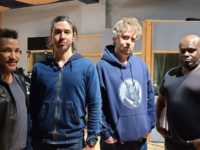
Okazaki amassed a scary amount of talent to help him carry out his conception but only about half of whom appeared on that prior album. There’s this 5-member horn section with Caroline Davis, Anna Webber, Jon Irabagon at saxophones and Jacob Garchik and Kalia Vandever on trombones. These are quality leaders in their own right. So is the pianist Matt Mitchell and drummer Dan Weiss. And then Okazaki chose go with two gifted bassists — Chris Tordini and Hannah Marks — to hold down the bottom.
“Magic Hour” provides a tantalizing hint of how this dectet will be deployed, unusual chords and the unusual juxtaposing of horns with Okazaki’s acoustic guitar, but the out-of-the-box ideas are just getting started. “Boomtown Girl” is a rubato, something that takes a lot of coordination when ten people of involved. The band makes it work seemingly by acting as two or three smaller combos working in concert with each other.
“Thermopolis” gets groovin’ from Weiss’ 2-2-4 beat pattern and it’s about the only constant on this song. The woodwinds are combative, trading licks (along with Okazaki) increasingly confrontational until it culminates into the theme that quickly breaks down.
“Hole In The Wall” rides on a late 60s groove but harmonically it flirts with dissonance and microtonality (was quarter tone or fretless guitar involved here?), as Webber bends harmonics and Okazaki adds a rough edge to it. Weiss sets a lopsided rhythm for “Bighorn” and Irabagon — on soprano sax — offers up manic quips before the whole horn section leaps into the theme. Afterwards, Garchik advances thoughtful lines that closely aligns to the ascending motif.
“Recluse Road” takes a Halvorson-esque path down its note progression, with Okazaki trading licks with Irabagon (this time on tenor), giving one a lot to contemplate even as it goes for only a little over two minutes.
“Ten Sleep” is a shapely chamber-jazz piece, Mitchell supplying a delicate reading of the motif as Tordini and Marks discreetly conduct an active dialogue right below the surface. Okazaki uses the occasion of “Devils Tower” to shred, steadily building up with the full weight of the ensemble to reach a cataclysmic conclusion.
So yes, Miles Okazaki did technically make another ‘big band’ record, but that term is so constricting to what he set out to achieve. Boomtown obliterates easy categorizations because he and his cohorts have both the audacity and wherewithal to make a record like this.
Boomtown is available now and obtainable from Bandcamp.

- Rich Halley 4 – ‘A Distant Land’ (2026) - September 11, 2026
- John Hollenbeck & the Hot Club Jazz Orchestra – ‘Peace and Justice’ (2026) - September 9, 2026
- Satoko Fujii Orchestra Berlin – ‘Second Attempt’ (2026) - September 1, 2026