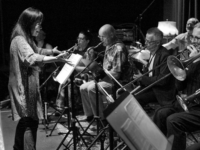
We continue with the conclusion of our interview with Satoko Fujii, as the highly originative composer, pianist and bandleader provides the background on more of her recent orchestral releases and a preview of what’s next for her. We also delve into her composing regimen, recording live versus studio and some interesting advice she got from her mentor who happened to be a legendary jazz pianist. Part One can be found here. Below is the second of our two-part interview:
S. Victor Aaron: So we’re three down, two more to go with your new orchestra records. I know you got one coming up on October 2 (2026), that’s in Nagoya and the Orchestra Tokyo record coming out on November 6th. Can you kind of give us an overview of what each of these records will offer? What new tricks you’ve got up your sleeve?
Satoko Fujii: Each release has a story and the last one, Kappa Ondo by the Orchestra Tokyo, actually, is dedicated to Natsuki’s father who passed away thirty years ago already. (Note: Natsuki is Natsuki Tamura: trumpeter, composer and bandleader, and husband of Fujii). He was an educator, a pioneer educator of the handicapped and also a painter; he actually did many things. He was an author, and he also played some music and composed.
S. Victor Aaron: What instrument did he play?
Satoko Fujii: He played everything. I think Natsuki inherited his natural sense, which he can, you know, he believes in himself; he can do whatever he wants. I’m not like that person where I see some new instrument, I feel like, okay, I have to practice. Natsuki is different. He can just pick it up and play it, and it works.
Natsuki’s father played, I think, violin, piano, koto — a Japanese instrument — many different things. His father who was a teacher for handicapped people, they had an annual concert that the teacher made on theater for the students. He wrote the story, and he wrote the music for that. Natsuki’s older brother actually sent Natsuki (a recording of) his singing of that song, because he remembers. I was so moved, because it was a beautiful piece, and, that’s the thing I probably cannot write. Very simple, but very beautiful, and maybe that’s because he didn’t get any musical education. And so, I wanted to arrange for that (piece).
So that’s the Tokyo orchestra. And also, Natsuki and I decided to write pieces, dedicated to him. And, he was a painter, wrote many, drew a lot of, very cute, charming paintings. And always, he wrote about, like, you know, cats, or blackbirds, crow, or, that kind of different things.
So, we wrote pieces for that.
For Orchestra Nagoya (Korekara), the alto saxophone player in the band has a cafe in Nagoya. He and his wife had that cafe for a long time, and they had some anniversary, like, 20 years or 25 years, I don’t remember. But, they wanted to make me write some new piece for them, so I did it. So, yeah, all orchestra have different stories. And actually, if you see the CD,
I mentioned about that in liner notes, a lot.
S. Victor Aaron: How does your approach to composing for an orchestra differ from how you compose for a small ensemble?
Satoko Fujii: Again, it depends. But, you know, I have a habit, custom …a routine… every day. When I go to my piano in the morning at the very beginning of the day, I spend at least fifteen minutes to compose. Sometimes I get only, like, five notes or two bars. But sometimes I can write a small piece. But anyway, I write something. I liked doing that for a long time, because my feeling is very fresh, and so I do that instead of practicing piano, some technique. It’s good time because I’m a morning person.
S. Victor Aaron: Do you sometimes compose for a particular band member in mind?
Satoko Fujii: Yes, I do, sometimes. For example, I will have a concert with Natsuki and Tatsuya Yoshida as a rock drummer, just three of us, at the end of this month. And we decided to use new pieces. We already have one CD out (Baikamo). But, we want to have new stuff so we decided that we would each contribute a new composition. It’s nice, because we are very different, so that already makes some variety, variation. So now I’m just focusing on making one piece for that ensemble.
S. Victor Aaron: Alright, so you gave us the stories behind the five orchestra records that came out and are coming out. What about that sixth orchestra, Orchestra New York? Is that coming up next?
Satoko Fujii: I’m planning that one in the next year. It’s kind of tough traveling now, because of the whole world situation, so I just saved it for next year.
S. Victor Aaron: You had just mentioned that you’re currently working on a project with Natsuki and Tatsuya. Are there some other projects that you’re working on right now with smaller ensembles?
Satoko Fujii: Well, actually, next week I have a recording session. One show and one recording session with my strings project: two violins, one viola, piano, bass, drums. And I made new suite. So, we will have a show, and two days later, we go to the recording studio.
S. Victor Aaron: That brings up an interesting thing I’d love to know about. I do notice that some of these recordings that you do are recorded in the studio, and sometimes they’re recorded live. When you’re recording live, is it a different feel, or a different vibe than when you’re recording in the studio?
Satoko Fujii: Yes, both have a good thing and a bad thing. When we record in concert, that’s, of course, very exciting with the audience. And, my Orchestra Tokyo sounds so different when they know that it’s recorded (in the studio). The microphones in front of them sounds so different, I don’t know. Otherwise, they are having fun. So, when we play a concert they are having a party. But, with microphones (in front of them), they sound totally different.
S. Victor Aaron: So, do you feel like they loosen up more in concert?
Satoko Fujii: If they have a microphone to record into, they sound different. Yeah, and without microphones, looser, yes. In the recording studio, we don’t have an audience. We can get energy from an audience, always. So, that’s great.
S. Victor Aaron: So, where do you feel like are the benefits when you record in a studio over a concert?
Satoko Fujii: At first, sound quality; no noise. And, also, when I’m not happy with something,
we can do it again, or we can edit. So, that’s a big difference.
S. Victor Aaron: I must say that the concert recordings are still very good quality. A lot of times, I forget that it was recorded live.
Satoko Fujii: That’s good!
S. Victor Aaron: And, I think because there’s so much unpredictability in your music, If someone made a mistake, I probably would never know.
Satoko Fujii: I know!
S. Victor Aaron: Are there mistakes in these concert recordings that got on record that we didn’t know about?
Satoko Fujii: I wouldn’t say anything.(laughs)
S. Victor Aaron: Ha ha ha, “no comment.”
Satoko Fujii: But, you know, always, not just big band, when I play my solo and even with improvised music, I felt like, “oh, this is a mistake.” But no one knows, except me, of course. Yeah, that’s the point. I mean, my compositions, we play melody nobody knows. So, how can we find out the mistake? And also, mistake is not mistake.
S. Victor Aaron: I think it was Miles Davis who said there are no wrong notes, is that kind of the philosophy you follow, too?
Satoko Fujii: Yes. Well, actually, my teacher Paul Bley, told me… If you hit the wrong note,
play that note three times. Then it becomes the right note. That is really profound.
S. Victor Aaron: What were the important lessons that you drew from him aside from the one you just told me about? Were there any other lessons you got from him that stuck with you?
Satoko Fujii: He was just, incredible. I got a lot of things from him, and I still remember one thing when I asked him, particularly my piano playing. When I play left hand and right hand together, unison line. Because my left hand is slower than my right hand. My right hand, It’s much better. So, I cannot play so fast, because my left hand is not good enough to do that.
And Paul said, “listen to Ornette Coleman and Don’t Cherry. They don’t play quite together.
They play unison lines, but they don’t play quite together. Yet, people listen and think it’s unison. Your right hand and left hand don’t need to play exactly together, they just have to make the same shape.”
Find Satoko Fujii’s albums for sale on Bandcamp.

- The Orchestral Side of Satoko Fujii: Something Else! Interview, Part 2 of 2 - October 23, 2026
- The Orchestral Side of Satoko Fujii: Something Else! Interview, Part 1 of 2 - October 22, 2026
- Thollem – ‘DoReMiantiFa Symphony’ (2026) - October 14, 2026