Click through album title for purchase information:
Principle isn’t just a title, it’s a thesis. Toto keyboardist Dennis Atlas builds this solo record from the inside out: instinct vs. intention, control vs. surrender. The songs were born in hotel rooms, finished in studios, and sharpened by a cast that only appears when the music demands it — not before. The result? A solo album that plays like a band statement without losing Atlas’ singular voice.
“Surprises From Within” kicks things off in fine form. Atlas sets the tone: inner truth as ignition. Marco Minnemann detonates the track with kinetic precision, while Steve Bonino anchors it with muscular bass. Atlas stacks guitars and keys with intent, not excess — this is controlled combustion. The “principle” starts here: power begins internally, then explodes outward.
The song, “Violent Power,” was co-written with Bonino. It is the manifesto single. Minnemann returns, pushing the song into overdrive while Atlas handles everything else — vocals, guitars, keys, bass — with surgical layering. “Violence” here isn’t destruction, it’s force of will. The hook lands like a mission statement.
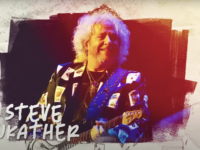
“Scare Me” is a a change of pace. The song is a two-man duel. Atlas builds the framework then hands the spotlight to his Toto boss, Steve Lukather, and the Lukather responds with a solo that refracts rock through jazz phrasing and melodic instinct. It doesn’t just elevate the track; it redefines it. Fear becomes theater.
“Games” is complex, theatrical, and vocally daring. Atlas drops into a lower register, shadowed by Toto bandmate Joseph Williams, using his low register too. Drummer Shannon Forrest drives the architecture. Ron ‘Bumblefoot’ Thal enters and detonates the solo — starting melodic, ending in controlled chaos. David Paich adds shimmering keyboard textures that glue the ambition together.
“Instincts” thematically touches on Internal conflict, externalized. Forrest’s drums are tight but expressive, Trev Lukather contributes textured guitar, and Paich colors the edges with Rhodes-like warmth. Atlas layers synths and bass beneath a melody that wrestles itself into clarity. This is philosophy disguised as prog-pop, and it’s wonderfully played and expertly arranged.
“Different World” shakes things up by slowing things down. It’s just Dennis Atlas and a piano — and that’s the point. No guests, no embellishment. The most direct emotional statement on the album, written according to Atlas, almost unconsciously, as if it arrived fully formed. It’s restraint as power. Instrumental swagger is on full display with “Candy on Mars.” Atlas’ bass — guided in spirit by “advisor” Toto bassist John Pierce – is filthy-funky, while Lukather injects pure groove electricity. Co-written with Lukather, this one feels like a jam that found its final form in the pocket.
The weirdness continues with “When the Monster Attacks.” Dark, psychological, and deliberately ambiguous. Forrest is unleashed here, shaping the track in real time while Atlas builds the sonic tension. The “monster” is internal control, insecurity, illusion. One of the album’s eye-opening conceptual peaks. The sleeper masterpiece may well be “Save It For Tomorrow.” Atlas leans into his evolving palette with a tune that is part Steely Dan sophistication, part arena-prog ambition. Greg Phillinganes adds polish and harmonic depth, while the Swiss Army Knife that is Warren Ham delivers a sax moment that seals it. It’s playful, complex, and alive.
The album closer, “We Can Be the Future,” is a family affair. Bonino returns on bass, Paich adds keys, and Atlas’ brother, Roger Atlas, contributes guitar — bringing the story full circle. Driven by Atlas’s own drumming and piano, it closes the album with forward motion and personal history intertwined.
Principle succeeds because it never loses its center. Atlas may bring in elite players such as Lukather, Paich, and Minnemann, but only when the music demands their voice. This isn’t a showcase. It’s a powerful statement. This is a major step forward. Not just from his debut album My Magical Wonderland, but toward something larger — an artist learning when to lead, when to collaborate, and when to simply let the song arrive.

- ‘Boy George and Culture Club’ (2026): Movies - July 19, 2026
- Supertramp – ‘Crime of the Century: In Concert at Hammersmith Odeon 1975’ (2026) - June 19, 2026
- Yes – ‘Aurora’ (2026) - June 11, 2026