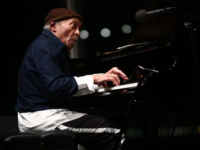
There has been a recent resurgence in the release of archival concert recordings by the premier pianist of jazz’s avant-garde, Cecil Taylor. There will be more forthcoming, but probably none in this current batch more important than this capture of a September, 1969 concert in Paris, France. Fragments: The Complete 1969 Salle Pleyel Concerts (April 18 2026, Elemental Music) finds the Unit right near the end of its original run before Taylor retreated into teaching and largely shunning public performing for the next three-plus years.
Any new Cecil Taylor release is a revelation; even if he was playing composed music, his improvisation spirit took over every time he sat down in front of the piano, in front of an audience. You can feel his music following a design and at the same time, you can’t predict where it’s headed. Jazz as ‘the sound of surprise’ meant more when it came to Cecil.
But the Salle Pleyel Concerts held an additional treasure: it’s a rare Cecil Taylor Unit recording from when the usual Unit trio of Taylor, alto saxophonist Jimmy Lyons and drummer Andrew Cyrille had a fourth member: the multi-reedist Sam Rivers. Only one Unit album with Rivers — who was only in the band over most of 1969 — has ever been released. It was a pair of concerts from that July performed at Fondation Maeght, The Great Concert of Cecil Taylor being this release’s best-known title. To this day, it still hadn’t been released on compact disc.
This wasn’t the first time Sam Rivers joined a band led by a jazz luminary; in 1964 he was in Miles Davis’ quintet, taking the sax chair for a few weeks just prior to Wayne Shorter taking it over. However, Rivers’ jazz conception was radical compared Miles’ at the time; the few recordings of the quintet performing during this time confirm him being a square peg trying to fit into a round hole. Rivers found himself more at home in Taylor’s Unit, settling in quickly with a threesome that had already played together for five years.
For this occasion in Paris, his Cecil Taylor Unit was playing variations on a composition “Fragments of a Dedication To Duke Ellington” that Taylor wrote for the occasion of Duke Ellington’s 70th birthday earlier in the year.
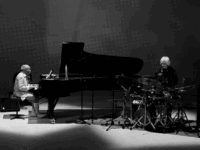
“Evening Set Version” is the shorter and later depiction of “Fragments,” but is ordered on this 2-CD set first. It’s forty-nine minutes of ferocity, not Taylor at his most subtle for the most part but certainly visceral. Early on in the performance Lyons and Rivers leave behind statements that fit this mindset. But after that it’s just Taylor and Cyrille hammering away. As Taylor plays — ahem — all the notes, Cyrille’s drums is remarkable in how much sonic space he’s able to occupy, dipping into the territory where the missing bass player would be. When the saxes return at about twenty-nine minutes mark, they do so as a pair, quickly rising up from a murmur to a symphony of cacophony. When Taylor returns to the front of the line, he brings a little bit of nuance, variation and even hints of conventional melody, but eventually returning briefly to the off-the-hook attack of the earlier excursion. Afterwards, Rivers reappears but with the flute. At first he’s somehow shadowing Taylor’s furious scurrying before soloing right alongside the piano. That recording didn’t capture him as well as one would have liked initially, but he can be heard making some daring note runs rarely heard from this instrument in the sixties after Eric Dolphy’s death.
The “Afternoon Set Version” is more than an hour and a half of continuous performance, the first twenty minutes completing the first compact disc and the rest taking up the entirety of a second disc. “Afternoon Set Version: Part 1” showcases Lyons and Rivers, which highlights the contrast in sax styles between Lyons and Rivers. Rivers is rough ‘n’ ready, feeding on Taylor’s energy while Lyons will locate a melody buried deep in Taylor’s free forms and extrapolate on it.
“Part 2” of the afternoon set picks up where Taylor moves from the comp role to lead, making a ruckus with his right hand while his left hand suggests the parameters he’s working within. Rivers soon sets off ripples with his flute, causing Cyrille to adjust his percussion line of attack accordingly. The last missing element rejoins the band when Lyons returns, using the high end of his alto sax’s register to get into the same tonal neighborhood as Rivers’ flute. Fast forward another ten or so minutes and Rivers reappears with a third and final weapon: the soprano sax. Taking it to places where even the mighty Coltrane feared to tread until he was near the end, Rivers is soon joined by Lyons and they find communion in the chaos. When it becomes just the Taylor/Cyrille show again, Cyrille asserts himself more this time, soloing over Taylor; using the word “soloing” very liberally here because as he’s improvising he remains locked in to the pianist’s explosive cadence.
You’d think they’d eventually run out of new ways to keep the plot moving forward but they just don’t. Sixty-eight minutes into the afternoon set, Taylor decide to take his foot off the pedal if only for a brief moment, creating sonic space not heard elsewhere. And then there’s this knock-down, drag-out tenor/alto sax duel where Rivers and Lyons test the upper limits of their horns together with Taylor’s piano egging them on.
Fragments: The Complete 1969 Salle Pleyel Concerts adds to the very scarce Cecil Taylor Unit with Sam Rivers discography, and we have Zev Feldman to thank for that. He worked with Cecil Taylor biographer Phil Freeman, retrieving the original tapes from France and producing the final product together for Elemental Music, an archival jazz records outfit Feldman co-founded to bring out of obscurity exciting jazz recordings by the giants of the genre. There could hardly be a more perfect subject for such a mission than Fragments, an historically important document of four giants pushing jazz out to its very limits.

- Rich Halley 4 – ‘A Distant Land’ (2026) - September 11, 2026
- John Hollenbeck & the Hot Club Jazz Orchestra – ‘Peace and Justice’ (2026) - September 9, 2026
- Satoko Fujii Orchestra Berlin – ‘Second Attempt’ (2026) - September 1, 2026