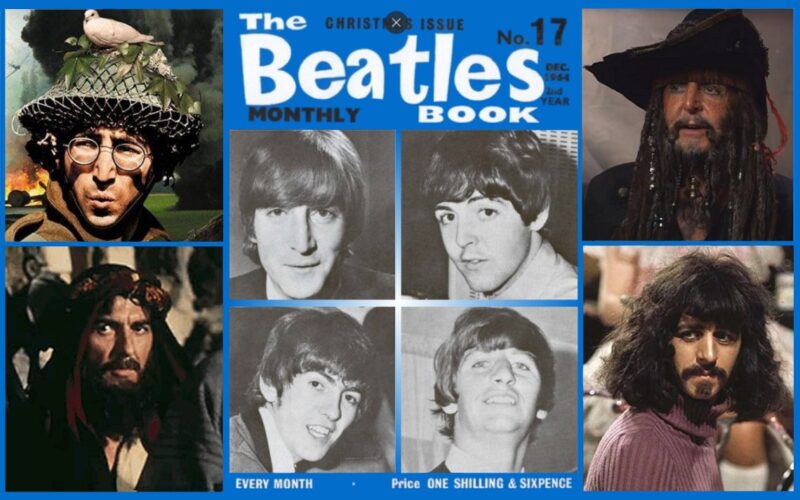
After Beatlemania exploded in 1964, United Artists struck a three-picture deal with the Beatles. The band clearly had fun making their first film A Hard Day’s Night, as it was a dramatization of the excitement they were already experiencing. But for their second film Help!, the four members didn’t feel fully integrated or invested in the “good Beatles guys vs. assorted bad guys” storyline. As noted in The Beatles’ Charismatic Help!: 60 Years Later, much of the plot with its various gags could have been much the same with different characters in another movie. They recognized something Richard Lester later stated about the approach taken in Help!: they were reacting to concocted events as opposed to being front and center as they were in their first film.
On pages 167 and 169 of the 2000 edition of The Beatles Anthology book, John Lennon summarizes the band’s displeasure with the end result of Help!: “It was out of our control. On A Hard Day’s Night we had a lot of input … but with Help!, Dick Lester didn’t tell us what it was about. … We went wrong with the picture somehow.”
It’s not hyperbolic to state their reaction to that experience changed the course of history, both of their own landscape and that of popular music. This was crystallized in an essay from the book included in the 2022 deluxe box set for the rerelease of Revolver titled The Road to REVOLVER by Ken Howlett.
Towards the end of 1965, the original plan for a third feature was in 1966 to repeat the schedule of the previous two years: film-related activities occurring during the first months with the finished product to be released later that year. The script chosen was to be an adaptation of the novel A Talent for Loving by Richard Condon, which Howlett describes as a “surrealist twist on a cowboy story set in the 19th century.” Filming was to commence in either Mexico or Spain, with Richard Lester again directing.
The Beatles Book fanzine provided Howlett the sequence of events behind the movie project, as was reported in real time. (Note that the essay titled the publication The Beatles Book Monthly, which has been used as an alternate.) Exploring the actual issues revealed a great deal of startling insights not covered in Howlett’s Revolver essay. This fanzine was somewhat official; while it mainly consisted of content and contributions from and for fans, there was also actual news directly from the band members and their staff (e.g., a column from then-tour manager Neil Aspinall).
On page 31 of the July 1965 issue, Paul McCartney is quoted that if not for the filming of Help! the band would have planned a spring tour that year. His quote is a clear indication that any time taken to shoot a film would mean their major activities – primarily recording and touring – would have to wait.
The October 1965 issue reported that the Condon book adaptation was still in play. (Page 3 editor Johnny Dean states that the Beatles have “all seen the finished shooting script.”) Due to Lester’s other projects, however, the filming couldn’t begin until the following April. That slip alone was crucial as it would disrupt the Beatles’ already hectic schedule, which was about to take a drastic turn. On page 29 of the November 1965 issue, it’s revealed that the Beatles had become unhappy with portions of the script. (The fanzine erroneously referred to the project as A Kind of Loving, which happened to be a 1962 drama directed by John Schleshinger.) It’s easy to assume that the problems they identified in Help! resulted in their becoming savvier about movie production overall, including providing script feedback to ensure it would justify devoting their time.
The December 1965 issue mentioned that the adaptation of the Condon book would be jettisoned but the script would still retain a “western element.” The band members’ fanzine comments makes it apparent that the treatments presented to them included something conceptually akin to Help!, in this case as cowboys. In the supplemental materials on the Help! DVD, costar Eleanor Bron mentions how in that film the Beatles wanted to “actually act.” That in fact didn’t turn out to be the case but from the fanzine quotes repeated below they might have considered essentially doing that for a third film.
Fortunately, the Beatles Monthly issues preserved online offer a much clearer picture into the group’s thinking behind their expectations. On page 7 of the February 1966 issue, there is a feature called “Beatles Talk” where publicist Tony Barrow, under the pseudonym Frederick James (his two middle names), “lets his recorder listen in on informal conversations” between members, this time with McCartney and George Harrison.
Harrison’s comments make it clear they didn’t want to repeat what was established in the first two films, instead wanting a totally different approach. The story might contain music, but it might not be a musical. It might have characters where the members keep their names, but they might not be in a band. “What we’ve been discussing with Walter Shenson is the idea of doing a film where we can still be called John, Paul, George and Ringo, but the story doesn’t have to revolve around a group called the Beatles. Then we can be four different individuals. … We needn’t even be together as a foursome all the way through. We can meet up during the story.”
McCartney was dismayed by the number of ideas that they rejected which all keyed off the Beatles themselves, as their movies had already done not once but twice: “There’s nothing wrong in those themes first time around but we’d rather get away and do something totally different for the third picture.” Responding to Harrison’s assertion that the Condon book was a great basis for a story but needed to have a “more straightforward plot,” McCartney says he recognizes that a western might have comic possibilities – if not now then maybe for a future film. It might have been a good idea, but it’s not one they absolutely had to do.
Harrison comments that barring a “script-type miracle” the band had ruled out using A Talent for Loving altogether and that Shenson has been searching for other script ideas. McCartney echoes that what has been submitted keyed on their “other films and image as a group. It’s difficult to get across to [those submitting script ideas] the thought of having a Beatles film with a non-Beatles story.”
Title tunes aside, songs would not be written then shoehorned in as they had been with the first two films and would directly tie into the movie’s narrative. McCartney argued, “The best way is to have the finished script and know the whole story really well before planning the songs.”
In these comments, the two Beatles only mention producer Walter Shenson searching for the right script, and nothing about director Richard Lester. Looking at the first two films created with Lester and reading their comments in those Beatle Books issues, the band — and in all likelihood even Lester — had determined that their collaboration had run its course and recognized it was time for a change.
On page 29 of the March 1966 issue, there is a section titled “Script Surprise” mentioning that Shenson found what might be a suitable script that is “basically a Western!” but the Beatles have not yet read it. It’s not until the September 1966 issue before any movie news is reported, although what appears on page 29 isn’t about a follow-up to Help! Instead, they mention that Lennon slated to act in Lester’s farcical World War II satire How I Won the War.
Eventually, their dissatisfaction with the third film script’s development coupled with a later-than-expected production start date led the Beatles to finally cancel any immediate movie plans. Their schedule no longer included recording songs for inclusion in a film or for getting in front of the cameras. For the first time since Beatlemania consumed the band’s existence, they were able to take a break from virtually all public-facing activities. Ironically, that pivotal event and everything that followed can be traced directly to their determination to avoid the Help! formula that kept rearing its ugly head in the script submissions.
Freed from any movie-related activities, the Beatles used that time to write and record with an eye to what was happening in the world, fueled by innovations in recording techniques, changing attitudes towards fashion and sex, experimenting with mind altering drugs. They were both influencing and being influenced by their musical peers. Initially, the resulting single was their first where both sides eschewed themes centered around love and romance with a sonic ferocity not heard previously – “Paperback Writer” and “Rain” – culminating in the ground breaking Revolver, which has been since recognized as one of the best Beatles albums – if not the very best.
At least their having the power to choose a suitable script was now within their control. By 1966, the Beatles had soured on the chaos they had come to associate with touring. The screaming during their concerts may have originally been a spontaneous reaction but after a couple of years, the constant and relentlessly overpowering noise had become more calculated. While the Beatles’ recording breakthroughs were taking them to new heights, their tightness as a live band suffered. That became painfully obvious when they toured Japan, as those audiences were quieter and more attentive, exposing the band’s sloppy playing, out-of-tune singing, and their growing disinterest. At one performance, as this video reveals at 2:59 at the end of “If I Needed Someone,” Harrison can be heard singing what very much appears to be “If I fucking needed someone.”
There were off-stage incidents that made performing difficult and unpleasant. American zealots described Lennon’s infamous “We’re more popular than Jesus now” quote as a smug and unapologetic boast. That led to gatherings mainly in the southern U.S. to burn and/or destroy Beatles records and merchandise. The outsized level of vitriol caused the band to fear for their lives when performing. Their infamous tour stop at the Philippines would provide a decisive turning point: When they chose to take a much needed day off, it was perceived by first lady Imelda Marcos as a snub, resulting in the loss of security to the airport and being stripped of their performing fees before they fled – a rare financial loss. Esquire later published a thorough and detailed telling of the entire visit and its aftermath.
For the Beatles, concerts had simply become a disagreeable chore and an unnecessary challenge, zapped of any pleasure that was once was derived from performing. By the final tour date at San Francisco’s Candlestick Park in 1966, the Beatles had already decided they had enough, and having completed Revolver sessions prior to this tour, their choice was clear. In retrospect, a movie might have been a welcome respite, but there was no acceptable script in sight to fulfill the creative thirst that live shows could no longer come close to quenching.
That set the stage for everything that would follow, when the counter-culture took hold and rock music would become more expansive. Lyrical themes became more effusive, even political, and other musical genres would increasingly sneak into recordings and concerts. The trajectory that the Beatles’ career would have taken may have been markedly different if they had taken the time to make a movie as originally planned. Their landmark Sgt. Pepper’s Lonely Hearts Club Band might have had a different shape — and impact.
After any planned western was dead in the water producer Shenson continued to seek a suitable script, probably more to satisfy the last of the United Artists three-picture deal. Apparently dissatisfied with a script he had commissioned, Shenson approached unconventional daring English playwright Joe Orton to make changes to it. The original concept centering on “four aspects of the same person” appeared to come closest to what the Beatles were seeking, and was light years away from the Beatles-as-live-action-cartoon submissions they had been refusing. (A detailed synopsis from Beatles Magazine listed a 2014 auction for writer Owen Holder’s original script.)
The Beatles Bible drew from Orton’s published diaries in describing his own involvement with what became Up Against It. The idea of four personalities inhabiting one being intrigued Orton, but he had other radical ideas. He anticipated the manuscript delivered to the band in February 1967 would be rejected by the Beatles outright. In his diary he said the Beatles “in my script, have been caught in-flagrante, become involved in dubious political activity, dressed as women, committed murder, been put in prison and committed adultery.” While that alone might have raised the eyebrows of less forgiving Beatles fans, comments from McCartney indicate that the script was declined because of its overtly gay themes. McCartney is clear the Beatles had nothing against gays (they accepted that was manager’s Brian Epstein orientation); the bottom line was they weren’t gay and this just wasn’t in their wheelhouse.
That reason ultimately worked to their advantage: Imagine the incendiary reactions of those religious fanatics who had already spread their venom using Lennon’s Jesus remark, if that movie had been made. The Beatles had little appetite for another major controversy.
In 1967, the Beatles mounted their own free-form television movie that was not scripted but followed an outline that facilitated largely improvised scenarios. Debuting on Dec. 26, 1967, on BBC One, Magical Mystery Tour followed the band taking a holiday on a bus full of colorful characters with eccentric happenings at stops along the way, peppered with new Beatles songs. But what they perceived as a creative lark was eviscerated by both viewers and critics at a time when expectations were high following their cultural milestone Sgt. Pepper’s. The Beatles’ official site contains a film summary, while a more in depth account can be found at Cinema Nerdz.
The 1968 psychedelic cartoon feature Yellow Submarine was distributed by United Artists and included an appearance by the Beatles at the very end. That wasn’t enough to satisfy the UA contract terms, which mandated the flesh-and-blood members (and therefore not animated depictions) were featured throughout the entire film. That stipulation must not have included that any film be scripted since the documentary Let It Be released by UA in 1970 finally fulfilled the final contractual obligation.
Before the Beatles called it quits, each member would make his own contributions to the movie industry. As noted, John Lennon acted in Lester’s How I Won the War (1967). Paul McCartney tried his hand at film scoring (with a little help from Beatles producer George Martin) on The Family Way (1966). George Harrison scored Wonderwall (1968) and the soundtrack album Wonderwall Music is considered to be his first solo album.
Ringo Starr would make a brief appearance alongside a large number of disparate and famous actors in the sex farce Candy (1968). The Magic Christian (1969) followed with Starr in a lead role as the adult adopted son of a bazillionaire played by Peter Sellers. The film further demonstrated Starr’s acting abilities, and is an audacious effort worth further detailing: The Magic Christian featured big stars (including Richard Attenborough, Raquel Welch, Christopher Lee, and Spike Milligan), notable cameos (including Yul Brynner in an outrageous turn), and actors who appeared in Help! Additional material was provided by pre-Monty Python members John Cleese and Graham Chapman, both of whom had brief uncredited roles; Chapman can be seen in the trailer, and Cleese has a meatier part that foreshadows his work with Python.
There are also ties to other Beatles: the soundtrack included the Badfinger-performed “Come and Get It” written by McCartney, and in newsreel-style footage Lennon and Yoko Ono are glimpsed boarding a luxury liner (and later in the dinner scene) along with Aristotle and Jackie Onassis, all portrayed by actors. McCartney and Linda Eastman visited Starr on the set twice: first on March 4 with Princess Margaret in attendance, then again on April 14 with Linda’s then-six-year-old daughter Heather. (The couple married in between on March 12.)
After the band’s demise, each member was involved in various film-related activities. Harrison released numerous films under his Handmade Films company, including Life of Brian, Withnail and I, and Time Bandits. Comparatively, McCartney only dabbled in movie making, offering Give My Regards to Broad Street and the Amazon Prime documentary Man on the Run, while Lennon mainly assisted Ono in creating her experimental short films. Starr continued to act in both movie and TV projects. His film works included Frank Zappa’s 200 Motels (along with Starr’s good friend Keith Moon), Ken Russel’s Lisztomania as the Pope (co-starring with Roger Daltrey and Rick Wakeman), and revisiting his teddy-boy era in That’ll Be the Day. Starr’s TV credits include acting as Mr. Conductor during the first season of Shining Time Station, an American spin off of the British program Thomas and Friends, on which Starr was a voice actor.
After the Beatles passed on A Talent for Loving, producer Walter Shenson made the film for Paramount in 1969. It starred Richard Widmark, Cesar Romero and Topol, and was directed by Richard Quine. The film included two participants from Help!: actor Jon Bluthal (who also played the car thief in A Hard Day’s Night) and film composer Ken Thorne. While it might have been very different if director Richard Lester had directed the Beatles, the uneven opening credits for the entire film on YouTube might be an indication that the band was right to decline making it.
In an alternate universe where a “Beatles” could be enormously famous as performers (and who are not artists), they would have simply left the movie script for the follow-up to Help! for others to work out – and then pretty much just do whatever was decided for them.
In reality, the Beatles were smart, creative, inquisitive and firmly in control of their destinies. Above all, they recognized their top priority: creating new and genuinely original music. It was this commitment to authenticity and innovation — strengthened by the frustrations they experienced filming Help! — that not only defined their career but with the game-changing Revolver also shaped the course of popular music for generations to come.
In the final installment of Mike Tiano’s examination of ‘Help!,’ he examines the music: the Beatles’ songs and the score from Ken Thorn.
Thanks to Rick North.
© 2026 Mike Tiano. All Rights Reserved

- How the Beatles’ Struggles to Follow the ‘Help!’ Movie Led Directly to ‘Revolver’ - February 20, 2026
- Reconsidering the Beatles’ Second Film ‘Help!’ - December 18, 2025
- The Beatles’ Charismatic ‘Help!’: 60 Years Later - November 26, 2025