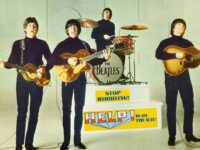
When the Beatles’ first film A Hard Day’s Night was released in 1964 Beatlemania was just starting to explode, and that film’s documentary-like approach conveyed the excitement felt by both the band and the public. When it came time to conceive their second film, everyone involved wanted its narrative to convey something different.
Director Richard Lester may have been successful in capturing the charisma of the Beatles in a film that would be titled Help!, but the project wasn’t without its issues. These include certain aspects that have not aged well, including the approach and culturally tone-deaf elements that in more enlightened times have become a source of open derision.
John Lennon had often been quoted that he wrote the title tune to mirror how he was starting to feel when the wave of popularity appeared to be crashing down on them. In a way, Help! as a whole would indicate that the Beatles were crying out when, as they would later conclude, they felt like extras in their own film – or put bluntly, they were in danger of losing creative control when they saw the direction the film was heading.
In Help!, these are the fantasy Beatles. They exist in a world where we know who they are but don’t see much of why that is. At least they had a roadie and a tour manager in A Hard Day’s Night. Here, there aren’t any personal staff aside from an occasional recording engineer or two. In the first film, the Beatles were on tour, so the omission of mentioning Lennon’s wife Cynthia and son Julian wasn’t an issue. Incredibly, there isn’t even one young screaming fan anywhere in sight. In fact, aside from the sacrifice candidate at the start of the film, there are zero fans anywhere.
The Help! deluxe DVD box set released in 2007, included a printed reproduction of Richard Lester’s annotated shooting script including his hand-written notes. Titled “Beatles Two,” there is a credit on the inside back cover where the distributor thanks Lester for the script, confirmed by the promotional press kit. The script includes scenes and lines that were added or expunged during production, including many filmed that didn’t make the cut. Toward the beginning of the film, Ringo Starr milks a cow at their home.
Another took place after the Beatles enter a car towards the beginning of the film and the cult members use an alligator tied to a stick (!) to try to remove the ring from Starr’s finger, which conveniently happened to be clutching down on the car window. There were cut scenes from the Bahamas preserved in the original trailer, where the band is seen tooling around in racing cars, and George Harrison is in a plastic dome being whacked by thugs (part of the Superintendent’s “very famous plan”).
For the most part, these cut scenes were inconsequential and didn’t affect the narrative one way or the other. But there was one lengthy scene towards the beginning of the film that consisted of eight pages (16-23 in Lester’s original script) that was shot then later discarded. There, the Beatles visit Sam Ahab’s School of Transcendental Elocution for Paul McCartney to take drama lessons. (That setup being discussed in the car was also removed, pages 13 to the top of 16.) In this scene, Ahab is accompanied by Lady Macbeth (Wendy Richards) in rehearsing lines with the Beatles where Sam tells the members to “transcend” with script directions, indicating that either the members would emulate a certain famous actor (for Starr, it was Lawrence Olivier) or we actually would hear that actor’s voice — the actual intent isn’t called out in the script.
Then the Eastern cult members enter the establishment in an attempt to secure the ring by playing hypnotic music to put everyone in a trance, with the exception of Harrison, who is inexplicably wearing earplugs. The dialog includes Ahme (Eleanor Bron) asking Clang (Leo McKern) if they are to just chop off Starr’s finger bearing the ring, or the entire hand. As Harrison isn’t in a trance, he tries to stop the cult from following through, resulting in a “meatcleaver” (sic) thrown at him but instead landing on a wall mirror. With that action the music stops, the cult members flee and the scene wraps up with the original participants.
Richard Lester has indicated that the scene was tailored for comedian Frankie Howerd who portrayed Ahab. Lester revealed in a DVD “making of” feature that he loved Howerd’s comedic style and thought putting the Beatles together with him would make for comedic gold. (A confirmation couldn’t be located that the band knew Howerd and wanted him in the film as mentioned here.) in the 2007 DVD extras, Lester maintains that the Beatles and the classically trained Howerd couldn’t get into the same rhythm, leading the director to remove the scene for the final cut. (That cut scene was destroyed and no surviving copy of the footage has appeared to date, only photographs taken at the time documenting it.)
From reviewing those seven pages in the script reproduction, this turned out to be a blessing. There may have been issues between the actors as Lester claims but the dialog as written might be what also contributed to the scene’s failure. Regardless, if the segment remained in the film it could have substantially slowed it down, throwing off the balance overall. It only advanced the plot by revealing a point that would occur later in Superintendent Gluck’s office where the cult call his phone, and only he is affected by the hypnotic music—the Beatles knew to plug their ears from the deleted sequence.
With the source of that reference no longer in the film, that continuity problem was minor compared to what appears to be a clumsy and totally superfluous scene. As “Sam Ahab” spelled backwards is “Bahamas” one might assume that there would be some plot mechanics that linked the two, providing a stronger reason for the existence of both. The only indication that was ever the case is hinted at in page 95 of Lester’s script. For most pages in the script there is no date, but certain sections include the date 18/2/65 (February 18, 1965 in British format). The main script was either written on that date with most pages not dated, or those pages were written then and inserted into an older, undated script. Either way the font is the same for all of those, but there are pages that are dated 6/4/65 (April 6) that are in a different font, clearly indicating they were inserted later. That includes the scene at the airport on page 95 where the band is in disguise.
In that scene, the Beatles actually discuss the destination being the character’s name backwards. Upon seeing a newspaper headline of the Beatles going to the Bahamas, Starr is first to speak in the scene; this is directly from the script, with my comments in brackets.
RINGO STARR: No – who’s let it out?
GEORGE HARRISON looks to see if he has and is happy to find out – from his bent position he comments:
JOHN LENNON: Never fear. [In the film Lennon tugs on his phony beard and says “Nobody will know.” The previous stage direction about Harrison appears to incorrectly name Lennon, or is out of place.]
PAUL McCARTNEY: We’re not [going there].
HARRISON: Spelt backwards it’s Sam Ahab.
STARR: Who told him – I’ll thump him.
LENNON: No, we just put it round we’re going there.
HARRISON: Is that why we’re going – how it came to you – Bahamas backward being Sam Ahab?
Shortly thereafter, the scene continues as it does in the film ending with Starr stating, “I wouldn’t mind going there” and in the finished film shifts to the Beatles finding themselves in the Bahamas. But in Lester’s script, the scene goes on for another two pages, numbered 95a and 95b with the action centered around some girls and a baggage handler. Page 95a reveals that Howerd might have made a return in this scene portraying an air traffic controller as the script notes that character “looks like Sam Ahab” and while he reads a newspaper revealing the Beatles destination he says, “My brother – that’s my brother – he knows them, says they’re a load of riff raff.” Those additional two pages were thankfully discarded and probably never filmed.
Some recent articles about Help! only assume that in the airport scene the band is in disguise to fool the press, but it’s actually to elude the Eastern thugs – since there is never any indication that any reporters exist anywhere in this film.
The eastern Asian-ist cult is primarily portrayed by English actors which in modern times is considered offensive. In his Showbiz Cheat Sheet article ‘The Beatles’ ‘Help’ Is Just Plain Racist,’ author Matthew Trzcinski acknowledges that “this phenomenon of casting white actors to play people of color did not start or end with The Beatles’ Help! While the Fab Four were innovative and ahead of their time in so many ways, they were sadly very much of their time when they made Help!, regurgitating prejudices and stereotypes of the time.” While inappropriate depictions of this sort wasn’t new in 1965 – and Trzcinski is right to ask, “Why has ‘Help!’ escaped that sort of scrutiny?” – his answer might be up for debate: “… it doesn’t matter much today … it has been arguably overshadowed [by the other Beatles films]. Considering it’s so offensive, it’s unlikely the movie will have a renaissance.”
Maybe so, but viewers may recognize these problematic depictions and still find that they enjoy the film for a number of other reasons — and there is one softball attempt to set the record straight. After the Beatles finish “You’ve Got to Hide Your Love Away,” Ahme pulls out a syringe with a humongous needle, causing Harrison to faint at the sight. “Now see what you’ve done with your filthy Eastern ways,” Lennon retorts, where in response Ahme shifts the blame to Clang: “No! It is Clang, the high priest, who is filthy in his Eastern ways,” changing the source to Clang, and not the East, as to who is actually “filthy.” Lennon counters, “How do we know you’re not just as filthy and sent by him to nick the ring by being filthy when you’ve lulled us with your filthy eastern ways?”
Then McCartney attempts to defend Ahme, though mildly: “What filthy ways are these?” The scene then shifts away from that conversation. Beyond the half-hearted attempt to absolve the film of eastern stereotypes writ large, the interchange poses questions that might be more than this comedy fantasy warrants. What exactly is Ahme’s motivation beyond helping the Beatles? It was her sister who was to be sacrificed, and in the intro she is the one who stops the ceremony to point out sis wasn’t wearing the ring. Was she involved and in an attempt to save her sister’s life even initiated sending the ring to Starr, so it wasn’t an impulsive move by a silly fan? It’s also worth noting that while the Beatles might have had issues remembering their lines they could deliver in other ways; here Lennon shines by using an affected, upper crust British accent in his last accusation to Ahme.
Beyond the awkward cultural portrayals, there is the fact that Kaili wasn’t fabricated by screenwriters Mark Behm and Charles Wood. Gordon Thompson sheds light on this actual goddess in his essay ‘The Beatles, Orientalism, and Help!‘ at OUPblog (aka Oxford University Press’s Academic Insights for the Thinking World): “Most Westerners have never quite grasped the importance of the Hindu deity Kali (presented in Help! as “Kaili”) and associated her with 18th and 19th Century Indian organized-crime families (thagis, the root of the English word, “thug”), some of whom had worshiped her. As the goddess of time, Kali also represents death, that great leveler of social classes and a figure both honored and feared.”
For the eastern “thugs” in Help!, that description isn’t far from what we get on screen, albeit in a skewed manner. This might be challenging to those who aren’t on board with accepting the usage of a deity in a farcical romp, but I’m guessing for most it’s akin to how Jesus Christ figures into Monty Python’s Life of Brian. In a 1979 televised debate on ‘Friday Night, Saturday Morning,’ John Cleese and Michael Palin made it clear that in their film, “the point is not to mock the teachings of Christ, but to show how people can be incredibly daft in the way they follow.” In other words, it’s not about the divinity; it’s about the followers, which can be also said for Help!
In a recent article, historian Philip Murphy recognizes the offensiveness of that entire plotline but doesn’t think the film should be in turn “hidden away.” “I wonder if an attempt could be made to salvage Help! by re-releasing it with its own documentary package exploring the historical context of the film,” Murphy notes. “While it would be difficult to make Help! genuinely palatable to contemporary viewers, it could be used as the starting point for a fascinating exploration of the ways in which Britain in the Swinging Sixties viewed its colonial past.”
At least the Kaili plotline had some meat on its bones. The entire mad scientist narrative is only predicated on obtaining the ring to help him “rule the world” — we never learn how in any possible way this is to be achieved. Granted this character is “mad,” but the cartoonish nature of that goal only adds to the illogicality of what we’re seeing. It’s further undermined when toward the film’s conclusion that pursuit of the ring is abandoned for possessing the serum that is supposed to shrink Starr’s ringed finger (which earlier in the movie resulted in a miniaturized Paul McCartney), again allowing Foot to “rule the world.”
What’s unfortunate is that both of those plotlines point to what may be the biggest problem in Help!, which is the audience is expected under the guise of a comedy to accept the violence that is threatened by those antagonists. That might have seemed logical if the film’s elevator pitch was “the Beatles in a James Bond movie.” There is one scene that no doubt stands out, in retrospect.
While we accept that the Beatles are not in any “real” danger, it’s still a bit hard to watch the scene where Foot pulls the trigger on John Lennon, even if we know the jammed gun would not have dispatched its intended target. Surely, the creators could have come up with a story that didn’t put the protagonists in harm’s way, e.g., the pursuit of something in which no one’s life depended on it. It would have been instrumental in moving the Beatles away from appearing as live action cartoons.
There were actual physical dangers the Beatles took during the production. One scenario might have happened during the skiing scene, where it was possible that being new to the sport one or more band members sustained an injury, putting the production and subsequent band-related schedules at risk.
However, there was one later scene that was actually life-threatening to Starr. It takes place on the yacht where Foot obtains the shrinking serum. While the villains are distracted, Starr and Ahme jump into the water. In one of the DVD/Blu-Ray extras, Bron revealed that after her plunge her cape got turned around and totally covered her head, which is clearly seen in the film. In addition once in the water Starr yells “I can’t swim!,” which as it turned out went well beyond a line of dialog.
While actor Victor Spinetti played different adversarial characters in both of the Beatles’ films, he became a good friend to members of the band. He continued to work with them in different capacities after Help!, including a role in the Magical Mystery Tour movie and directing a stage adaptation of Lennon’s two books In His Own Write and A Spaniard in the Works. According to Spinetti’s autobiography Up Front … (Robson Books, 2006), the plan for the yacht scene was for the action to occur in a single take with the production crew filming from “nearly a hundred yards away.” Upon the scene’s conclusion, swimmers would place Starr onto a small boat to bring him back to the yacht to dry off, then repeat the action for another take.
Spinetti recalls that after the second take Starr, still wet and shivering, asked if he really had to jump in the water a third time. When Spinetti inquired why, Starr repeated his line, but for real: “I c-c-can’t swim.” From the remote boat a crew member, who used a megaphone to communicate with the actors, asked what was holding up the third take, to which Spinetti shouted, “Wait a minute! Ringo can’t swim!” Apparently, no one had bothered to discuss this with Starr, who didn’t question it: “When you’re filming and the director shouts ‘Action’ you have to do it, don’t you?” Spinetti answered with a simple, “No,” and that put an end to any subsequent takes. (Spinetti mentions this story in that same clip.)
The experience of Help! largely convinced the Beatles that one movie like this was enough. It further reinforced their determination to not let others take control of their destiny. If there was to be a third film, they would have to take the reins for its conceptualization. Otherwise, they would be in danger of becoming the Monkees or even their Saturday morning cartoon incarnation: the same four characters put in yet another set of absurd situations.
The Beatles weren’t going to let that happen. If they did, the time wasted would derail their top priority, something they recognized as the best use of their valuable time: recording new music.
In the next installment of Mike Tiano’s examination of ‘Help!,’ the Beatles’ unwillingness to compromise leads to abandoning a third scripted live action film, resulting in the creation of one of their greatest musical triumphs.
© 2025 Mike Tiano. All Rights Reserved

- How the Beatles’ Struggles to Follow the ‘Help!’ Movie Led Directly to ‘Revolver’ - February 20, 2026
- Reconsidering the Beatles’ Second Film ‘Help!’ - December 18, 2025
- The Beatles’ Charismatic ‘Help!’: 60 Years Later - November 26, 2025