This is the first installment of Mike Tiano’s look at the film Help! 60 years after its release. Upcoming articles will include how cultural and narrative-related issues later diminished its standing for some viewers (including how a major deleted scene resulted in continuity disparities); how the Beatles’ dissatisfaction with the direction of a third film led to Revolver; and a discussion of the music featured in the film.
The Beatles’ first film A Hard Day’s Night dramatized actual events on and off stage and became one of the biggest hits of 1964. It was immediately embraced by audiences and, surprisingly, movie critics who deemed it the “Citizen Kane of jukebox musicals.” Director Richard Lester successfully created a film that had the look of a documentary but was actually scripted, accurately capturing the manic reaction when the Beatles broke through in America which resulted in the term “Beatlemania.”
It was more successful than was ever imagined by United Artists, the studio that released it—their main goal was to quickly benefit from the windfall of the music rights for what they suspected could be just a passing fad. While UA was only interested in its bottom line, producing A Hard Day’s Night as quickly and cheaply as possible worked to the finished product’s advantage from a creative standpoint, for both the Beatles and director Lester.
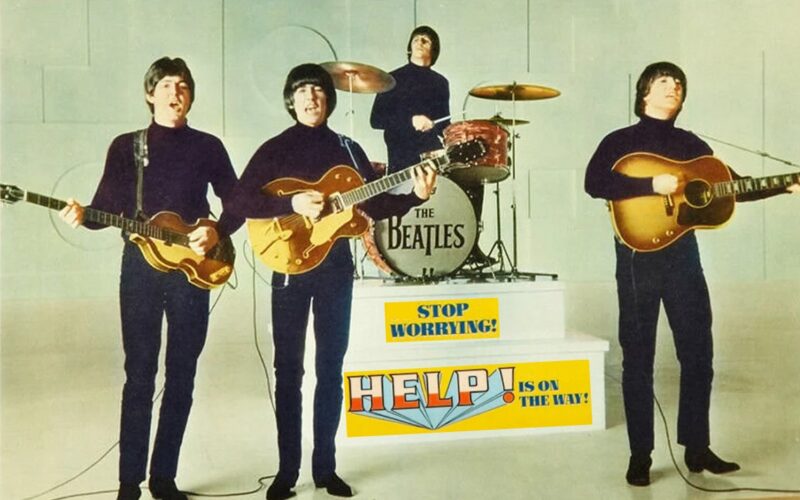
Buoyed by this experience Lester conceived the Beatles’ second film to contain a more elaborate production and richer content, with the intention of offering an altogether different approach. The result was Help! which was released in 1965, barely a year after their first.
Lester mentions Help! throughout the book The Beatles in Richard Lester’s A Hard Day’s Night: A Complete Pictorial Record of the Movie, with J. Philip DiFranco credited as Editor. Published by Chelsea House Publishers in 1977, the book’s concept was to follow the evolution of A Hard Day’s Night from script to actual conception. It includes a lengthy discussion between Lester and DiFranco as they go through the first film’s script shot by shot. Throughout this section, Lester imparts numerous anecdotes including references and comparisons to Help! The Lester quotes that follow were taken from that book with notated exceptions.
As the Beatles signed a three-picture deal, it was time to strike while the iron was hot and get a follow-up to A Hard Day’s Night into the theaters post haste. As the success of their first film was in no small part due to the director, that was in all likelihood a major factor in convincing the Beatles camp to put the next film in what they saw as Lester’s capable hands.
One element that originally brought band and director together: The Beatles greatly enjoying Lester’s absurdist brand of comedy, including the Oscar-nominated Running, Jumping and Standing Still Film. None of the parties were interested in A Hard Day’s Night Part 2 to cover much of the same ground from their first film, so Lester had the Beatles be “passive participants” in “a baroque fantasy in which they passed.”
By 1965, Beatlemania was in full swing with no sign of abating, which made it practically a foregone conclusion that the second film would be shot in color. Lester later revealed in an interview in extras included with the 2007 DVD/Blu-Ray release of Help! that he was instructed by management to film in countries outside of the U.K., the intent being to shield the band from exorbitant local taxes. Lester must have welcomed this since the globetrotting would provide story possibilities and colorful backgrounds.
Ringo Starr had a habit of making malapropisms, and in 2002’s The Beatles Off the Record: Outrageous Opinions & Unrehearsed Interviews by Keith Badham, Starr is quoted as inadvertently suggesting the title of their first film: “We went to do a job, and we’d worked all day and we happened to work all night. I came up still thinking it was day I suppose, and I said, ‘It’s been a hard day …’ and I looked around and saw it was dark so I said, ‘… night!’ So we came to ‘A Hard Day’s Night.’”
Starr has been credited with a similar attempt for the second film with “Eight Arms to Hold You” (though some sources credit producer Walter Shenson), conveying both the total number of Beatles’ upper limbs and those on the giant Buddha-like statue used in the film. When Capitol Records issued the “Ticket to Ride” single in advance of the film’s release, that title was printed on the record’s label: “From the United Artists release Eight Arms to Hold You.” By the time they agreed on using “Help,” the production staff discovered that it was already registered but without the exclamation point. By including this added punctuation, they were free to use that for the title.
The plot centers around a ring that Starr received from a fan who we learn belongs to an Eastern cult. The ring is required to complete the sacrifice shown in the film’s opening scene but Starr cannot get it off his finger despite numerous failed attempts. The script follows along as the Beatles are pursued by the cult (led by Klang, portrayed by Leo McKern) to complete the sacrifice regardless of who wears the ring. After failed attempts to remove it, the Beatles visit a mad scientist named Foot accompanied by his dim-witted assistant Algernon (Victor Spinetti and Roy Kinnear, respectively). When their efforts are unsuccessful, they decide they too want the ring so they can “rule the world.” The band is accompanied by cult turncoat Ahme (Eleanor Bron) in battling these antagonists, starting in England before inexplicably moving to the Austrian Alps. They return to the U.K., where they enlist the aid of Scotland Yard by way of Salisbury Plains (where Stonehenge sits) followed by the Royal Palace, leading to the conclusion in the Bahamas where Starr finally sheds the pesky ring.
Help! has been accurately compared to Monty Python comedy troupe and in the vein of the Airplane! and Naked Gun films. Abandoning the realism of A Hard Day’s Night, any attempt to consider Help! logically is futile, as it’s basically a live-action cartoon. Taken in this spirit, the movie follows the approach described in the DiFranco book where he quotes Lester from an unnamed source: “My ideal is a few gags, a few situations, and tremendous mobility in between.” With Help!, Lester achieved that ideal to the max.
Before it gets there, the pre-credits opening scene which depicts the start of the sacrificial event cunningly throws the unsuspecting viewer for a loop. In an era where a theatrical movie was part of a double feature, this was easy to achieve. With A Hard Day’s Night, there was no mistaking the subject when that film began with its title song’s now iconic opening chord. The first scene in Help! may have been the filmmakers slyly messing with the fans in the theater: Is this the second feature? Did the projectionist erroneously put on a reel from another film? What does this have to do with our beloved Beatles?
Once the Beatles do appear in the film, the gags are pretty funny overall, even if a great deal of those have little to do specifically with the band: Many of the setups could have been in a similar movie with different characters. One has to wonder how many of the gags Lester might have stockpiled over the years and here found an outlet.
The film’s depictions of each member were exaggerations of their own personalities (like John Lennon’s sarcasm) and even invented (Starr being irritating to the others). In the DiFranco book, Lester mentions that in A Hard Day’s Night, Ringo’s portrayal of being “sullen and put-upon” wasn’t based on the drummer whatsoever. “He was just chosen — even in Help!, in which it became more specific that Paul [McCartney] was the sexy one, John was clever and sarcastic, Ringo was lovable, and George [Harrison] was mean. It was really simple … so we were desperately trying to give them separate characteristics. … You know everything that George says in ‘Help’ had to do with meanness or money. That was a device to try and produce separate characters.”
The Beatles star was still ascending in 1965 and Help! was predictably a hit. Though film critics weren’t as generous with their praise as they were for A Hard Day’s Night, there is a lot to admire regardless of however one considers the end result.
The color cinematography is simply stunning: The Beatles’ multi-colored communal living space. The bright costumes worn by the band at Salisbury Plains and by Ahme in various scenes, including one gag where her pistol color matches her outfit. The various locales with their vibrant backdrops including the Bahamas, and in contrast the monochrome-like footage in the Alps. During “Another Girl,” Lester experimented with different color filters to add to the artiness of the proceedings. (In that sequence McCartney, who is “playing” a female like he would his bass, accidentally brushes his hand against her breast, resulting in his candid and totally honest facial expression.)
The advertising used the line “The Colorful Adventures of the Beatles are more Colorful than ever … in COLOR!” (sic), and that was the case when the film was first released. Over time the Eastman Color process would degrade into purplish tints, and it wasn’t until the restoration for the 2007 DVD/Blu-Ray release where the rich hues were painstakingly corrected. One bonus with the film having been shot in color is that future generations will be treated to seeing the Beatles as they existed in 1965, including the kinds of facial expressions and physical actions that they wouldn’t have normally exhibited in concerts, newsreels or TV appearances.
The film purports to spoof the James Bond films that were becoming popular during this time (including a reference to its musical theme which opened the album’s American release), embracing that series’ fantastic elements to deliver some of the more imaginative moments here.
The numbered attempts of the Eastern thugs to retrieve the ring includes the magnetized elevator and the washroom from hell. The scene where McCartney is accidentally reduced to miniature size allows him to have a bit of fun interacting with oversized objects while titillating those hoping to get a glimpse of him naked (though when he reaches for the gum wrapper to use as a toga it’s apparent that he’s wearing underwear). Foot’s contraptions, including the relativity condenser that slows down time. The Beatles jumping into the watery hole at the Bahamas’ makeshift temple then emerging in a hotel swimming pool, something that is never explained but added to the film’s illusory aspect.
Ultimately, what carries the film is the enormous charisma of the Beatles themselves, which was not lost on Lester. “I’m very proud of Help! because I think Help is as successful as Hard Day’s Night in terms of making four people enormously attractive to the audience. I think that a lot of the things that they did and the way they did them, the feeling of it — they were so bloody endearing, and I am saying this now, after having seen it just last week [in 1977]. And my wife and I said, ‘Oh my God, if they had never changed, if we had all never grown up. If the world was like it was in Help! … You forget what 1964-1965 was like. You could laugh. You could concentrate your whole energies on creating marvelously positive images of exuberance. And the Beatles seemed to be part of that.”
This harkens back to something mentioned in my earlier Something Else! article on Peter Jackson’s Get Back. Director Martin Scorsese wrote an essay for the 2007 Help! rerelease that called out something which is hard to deny. When listening to the Beatles’ music at that time, one’s connection to them might have been strengthened, and that was to be expected. But what we didn’t stop to consider was the “wonder” that grew out of the joy and exuberance that the Beatles provided.
In the final analysis, if one doesn’t look too closely at the proceedings, Help! is a lot of fun, even if it lacks the classic status of A Hard Day’s Night. But it does provide a lively reminder of why the Beatles were, and remain, a positive and lasting phenomenon.
There are various theories as to why they were rerecording vocals for the track at CTS after having already completed the song at EMI prior to this session, including being dissatisfied with the opening vocals. Another mentioned in the book had to do with a tambourine overdubbed by Starr on the album track. In the video being viewed at the start of the film, no one would be seen playing that percussion, and as the lead vocal track was physically shared, it could not be muted or separated, hence the subsequent session. The actual purpose might have been a combination of reasons that couldn’t be sourced, but the tambourine hypothesis would have revealed another similar issue: Lennon played a 12-string Framus Hootenanny guitar on the title song’s recording, but not in the movie. That was the guitar Lennon played for “You’ve Got to Hide Your Love Away” on both the album and in the film, which had recently resurfaced after being lost for decades. More on the CTS session can be found here, and accompanying photos can be found here.
© 2025 Mike Tiano. All Rights Reserved

- How the Beatles’ Struggles to Follow the ‘Help!’ Movie Led Directly to ‘Revolver’ - February 20, 2026
- Reconsidering the Beatles’ Second Film ‘Help!’ - December 18, 2025
- The Beatles’ Charismatic ‘Help!’: 60 Years Later - November 26, 2025