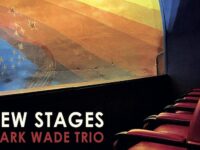
Click through the new album title for purchase information:
I have followed New York City-based bassist Mark Wade’s career since I reviewed his debut album with his trio Event Horizon in 2015. Now, a few well-received albums and several years later, Mark has signed to Dot Time Records, and this is his first release on the label.
Featuring his long-standing trio of Tim Harrison on piano and Scott-Neumann on drums, New Stages has been heralded as a turning point in Wade’s career. However, it should be seen not as a turning point, but as a continued progression toward the status this musician deserves.
New Stages brings together Wade’s experience and penchant for blending genres, making his work hard to classify. He reimagines classical compositions from the perspective of a modern jazz trio and draws on a range of works across the classical spectrum to create an expansive exploration of sound, composition, and collaboration that embraces the improvisational spirit of jazz as well as creating an interface with classical influences.
“I try to take inspiration wherever I can find it. Good music is good music, no matter what label you want to put on it,” Wade says. “I’ve played both jazz and classical music professionally for years, and some of the most inspiring sounds I’ve heard were from my experiences playing classical music in the orchestra.”
Wade has been collecting themes from large orchestral works and small solo works over the past eight years to fashion original music for his trio. “I’ve drawn from a wide variety of musical sources ranging from the Baroque period to modern day, always combining them with my own compositional ideas and perspectives,” Wade adds. “Is the result jazz music? Classical music? Something different? That is for every listener to decide.”
New Stages begins with a take on Debussy’s Children’s Corner Suite. While the original is a six-movement suite comprising “Doctor Gradus ad Parnassum,” “Jimbo’s Lullaby,” “Serenade for the Doll,” “The Snow is Dancing,” “The Little Shepherd” and “Golliwogg’s Cakewalk,” Wade takes four of the movements and creates inspirational interpretations.
“The Good Doctor Gradus” opens the album with a straight-in, no introduction, fast and furious rendition with dextrous piano, constantly moving bass, and delicate percussion – including a solo drum section that fades to a rapid-fire cymbal to close the track. “The Elephant’s Lullaby ad Parnassum” is a gentle, rocking number with a gorgeous discussion between the bass and the timpanic elements, interestingly taking the “Ad Parnassum” of the original “Doctor Gradus” (it means to aim for scholarly mastery) and attaching it to a lullaby.
“The Shepherd Takes a Turn” is bass-led and beautifully worked around the theme. The piano and bass share a call and response before digressing into a bass melody line and piano accompaniment, which works well. There are contrapuntal touches, which add to the interest in the middle section, meaning the listener remains engaged and is carried effortlessly to the end of the track, almost without pause.
“Cakewalk” is a slightly bonkers interpretation, with changes, diverse rhythms, and pauses that create intentional diversions, but it manages to retain a profound respect for the original, including the mesmeric swing section in the middle. It is a great vehicle for Wade’s bass solo, which emerges for the second third, joined by the drums and piano in turn for the final third. A joyful piece, redolent of the original but with a different take.
“Saga” is a thoughtful, emotive number with a soft approach from the musicians and another example of how Wade takes a theme and works around it, returning but regularly diverging into explorative sub-tracks. Beautiful. “The Storm” is Rachmaninov combined with Chopin – but not quite. Rachmaninov’s Piano Concerto No. 2 introduces the piece, and Chopin’s Prelude No. 24 in D Minor forms the mainstay, with a Wade take on everything, of course.
Which opus of Rachmaninov’s piece was not clear even from the listening, but the form and style are there. The quiet menace of the opening is spectacular, with Tim Harrison masterfully demonstrating the power of dramatic piano playing. The glide into the Chopin is silky, and the percussion maintains the slight menace set by the introduction, with the voice of the bass emerging, calm and steady. The major part of the number is all Mark Wade, and his solo has echoes of the Chopin Prelude, but is so original, you lose it for a while, until there it is, it returns – the piano re-asserts the theme and leads the way toward the track’s finale in Chopin style.
“Idyll” is based on Richard Wagner’s “Idyll” from the opera Siegfried, with a recurrent theme that is worked and re-worked beautifully. “Iberia Parts I and II” are taken from fragments of Rodrigo’s Concierto de Aranjuez, Nikolai Rimsky-Korsakov’s Capriccio Espagnol, Chick Corea’s “La Fiesta,” and some original music. Whenever you see Rimsky-Korsakov’s name, you know you are in for some wonderful rhythmic changes, and the tracks do not disappoint.
The Latin-infused rhythms are reminiscent of Spanish music, and the bass at times does the work of a Spanish guitar – but with more vibrato and warmth. In “Part 1,” Wade’s bass is highlighted in a dextrous solo, with arising ascent (and an echo of Chopin as well). “Part II” is very much a jazz trio number, full of joyful ensemble work.
“Requiem” is three movements inspired by the Requiem Mass by Maurice Durufle and comprises “Judgment, Transition, At Rest.” On “Judgment,” Wade’s bass leads in a thematic and dramatic number which contrasts with the delicately poised “Transition” and the sumptuous “At Rest.”
“Waltz and Variation” is based on Chopin’s Prelude in Ab Minor No. 69 and is an imaginative interpretation of the waltz, with Harrison setting the tone before the rest of the trio join to create a layered and creative track. “Lament” is simply beautiful – no other word can do this justice, while the final number is “Jesu” based on Bach’s Jesu Joy of Man’s Desiring and is respectful to the original, but with a Wade mark of distinction placed upon its melody.
In the end, Mark Wade’s New Stages is neither jazz nor classical and could sit easily in a concert performance billed for either genre. What it is, is brilliant workings of classical numbers – either fully re-worked or with a nod to the original and a jazz interpretation. This makes the LP somewhat akin to third stream but of course, not third stream per se.
It’s beautiful because it is unclassifiable, un-boxable. While record stores might not like that, listeners love it because there is something for every musical palette. Wade and his trio have come of age on this recording and created something genuine and original, backed by the influence of masters and proving that you can improve on original ideas. For the most part, I think those masters of classical music would wholeheartedly agree.
On New Stages, Mark Wade does what he does best: He redefines the bass as a lead instrument in modern jazz.
- Mark Wade Trio Comes of Age on the Genuineand Original ‘New Stages’ - April 5, 2026
- Stephen Godsall – ‘Tingling Skin, Buzzing Wires’ (2026) - March 29, 2026
- Rachel Sutton – ‘Realms’ (2026) - March 8, 2026